Your Chat Model Writes Brilliant Answers. Production Needs Typed Decisions.




Enterprise teams keep asking the same question. If chat models are so good at answering people, why is so much automation still stuck in pilots, brittle scripts, and human review queues?
Part of the answer is architectural. A model that is excellent at writing fluent text is not automatically excellent at making the kind of decision software can act on without a person reading the reply. Production systems need structured outcomes, honest uncertainty, and latency that fits inside a workflow, not a conversation.
A new class of decision engines is pushing that distinction into the open. Call them System One style models or typed decision engines. The product names will change. The enterprise pattern will not: unstructured state in, typed probabilistic decisions out, with the surrounding code deciding what happens next.
Chat LLMs are built for people. They generate strings. Those strings can be explanations, code, refusals, or something that looks structured until it is not. To use that output in a claims workflow, a credit path, or a knowledge gate, you still have to parse, validate, retry, and hope the model stayed inside the schema.
That hope is expensive. A retail assistant that invents a promotion is a customer service problem. A routing model that invents a queue name is a production incident. A guardrail that sometimes returns prose instead of a pass or fail flag is not a guardrail.
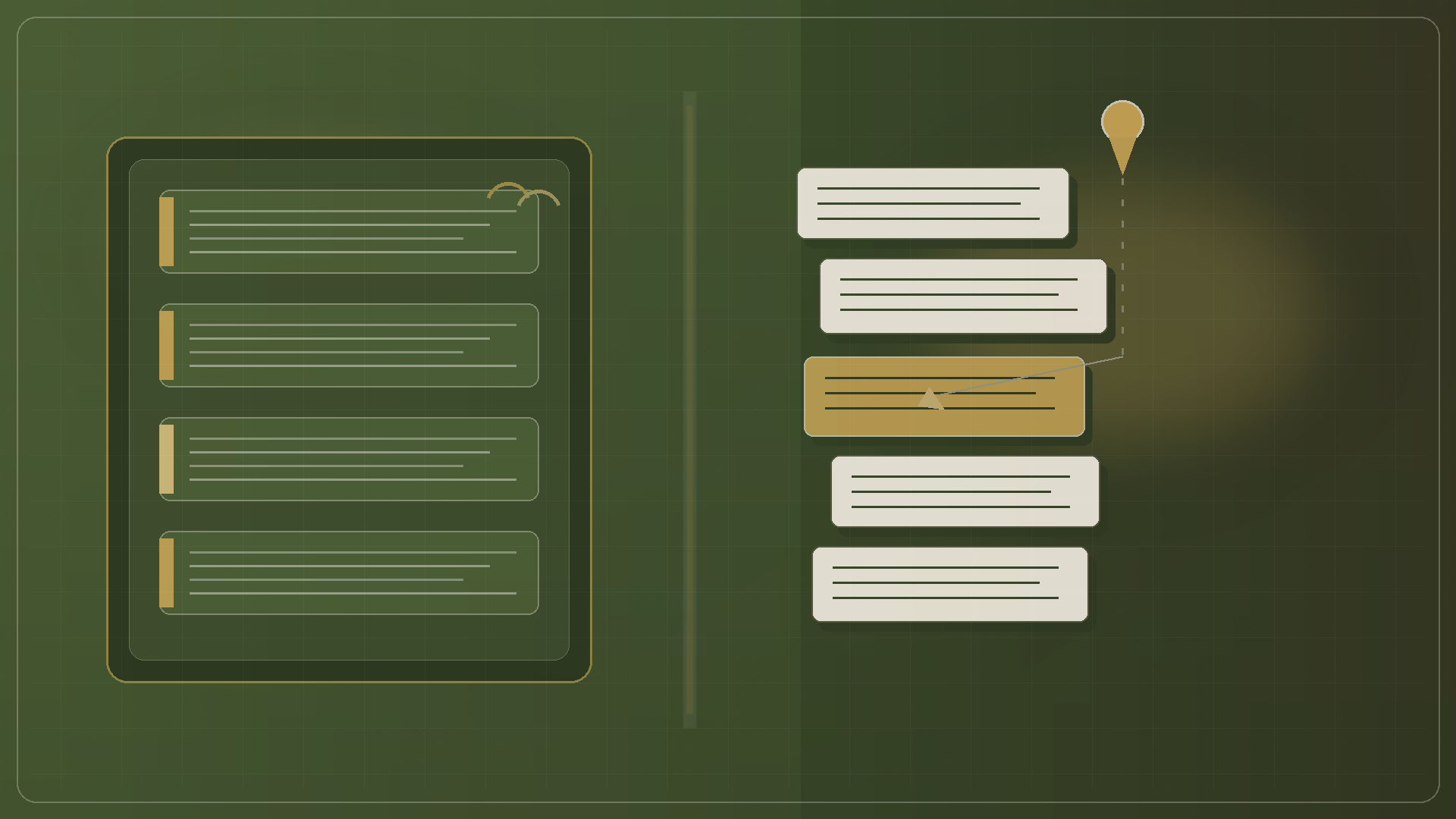
Typed decision engines flip the contract. Possible outputs are defined up front. The model returns structured values with calibrated probabilities and confidence scores. It cannot invent a category that does not exist in the schema. Software can branch on those values the same way it branches on any other function call.
This is not a replacement for every LLM use case. It is a better fit for the fuzzy decisions that sit inside ordinary systems of record.
Routing and triage. Send this ticket to collections, fraud, or first line support. Decide whether a citizen enquiry is eligibility, payment, or identity before a human ever opens it. The value is consistent labels with confidence, not a paragraph of reasoning that ops cannot index.
Scoring and prioritisation. Rank churn risk, case urgency, or document quality so work queues stay ordered. Downstream code can apply different thresholds by product line or state without rewriting the model prompt every sprint.
Guardrails and verification. Score whether an LLM answer is on policy, detect jailbreak attempts, or judge whether a retrieval citation actually supports the claim. When your generative stack is free form, you want a fast, typed layer that says accept, rewrite, escalate, or block.
Map reduce over large corpora. Turn millions of documents, emails, or case notes into structured features. Parallel decision calls that return typed fields are closer to a data pipeline than a chat session. That is how you get from demo RAG to something that can run overnight without a human reading every page.
Real time branches. If a decision has to land inside a checkout, an IVR handoff, or a trading desk UI, multi second token generation is a product tax. Sub second typed decisions let AI sit in the path of the user experience instead of beside it as a side panel.
Enterprises do not fail only because models are wrong. They fail because models are wrong with no usable signal that they might be wrong.
A chat model asked for a confidence score will often sound certain either way. A calibrated decision engine that returns probabilities you can trust changes how you design escalation. Above 0.92, auto approve. Between 0.7 and 0.92, send to a specialist queue. Below 0.7, hold and ask for more evidence. Those thresholds become policy, not prompt folklore.
For Australian banks, insurers, and public sector agencies, that is also a governance story. You can log the decision schema, the confidence, the model version, and the branch taken. Auditors can ask what the system did when it was unsure. That is harder when the only artefact is a free text completion.
None of this means you throw out generative models. Copilots, drafting, research synthesis, and code assistance still want string generation. Agents that talk to people still need language.
The mistake is forcing one interface to do both jobs. Teams paste a JSON schema into a system prompt, add three retries, and call it production automation. It works in the demo. It drifts in production when the provider swaps a model, the prompt grows, or an edge case produces a nearly valid payload.
A cleaner architecture is hybrid. Use generative models for human facing language and open ended synthesis. Use typed decision engines for the classify, route, score, extract, and verify steps that have to compose inside software. Let application code own the workflow graph. Do not ask a chat completion to be the workflow.
Start by listing the AI decisions already buried in your processes that look like if statements with soft edges. Customer intent. Document type. Risk band. Policy match. Escalation need. For each one, ask whether you need a paragraph or a typed value with confidence.
Then design the contract before you pick a vendor. Define the schema, the confidence thresholds, the latency budget, the logging fields, and who owns the escalation queue when confidence is low. Treat model choice as an implementation detail behind that interface so you can swap engines without rewriting the business process.
Finally, stop measuring automation success by how clever the chat demo sounds. Measure it by how often software can act without a person reading the model output, how often low confidence paths are handled cleanly, and how cheaply you can re run the same decision graph when volumes spike.
Chat models will keep writing brilliant answers. Production still needs typed decisions. Build for both, and put each one where it earns its keep.